
Would that Aaron Sorkin had taken Emily Dickinson’s ironic poem about “split[ting] the lark –and you’ll find the music” to heart. The first thing we hear is violinist Ashley Frith whose music is a thing of beauty. Then Sorkin takes an ax to Harper Lee’s TO KILL A MOCKINGBIRD and does exactly that. Presented by The Huntington and directed by Loretta Greco, Sorkin’s adaptation butchers the brilliant and moving novel on which this play is based. Harper Lee won a Pulitzer for the work which grew out of a deep understanding of the society in which she was raised. Her characters are warm and alive, with the recognizable sensibilities of folks young and old, kind and nasty, Black and White living in a dusty depression-era town in the Jim Crow south. The tale reaches for profound truths about humanity and individual moral choices.
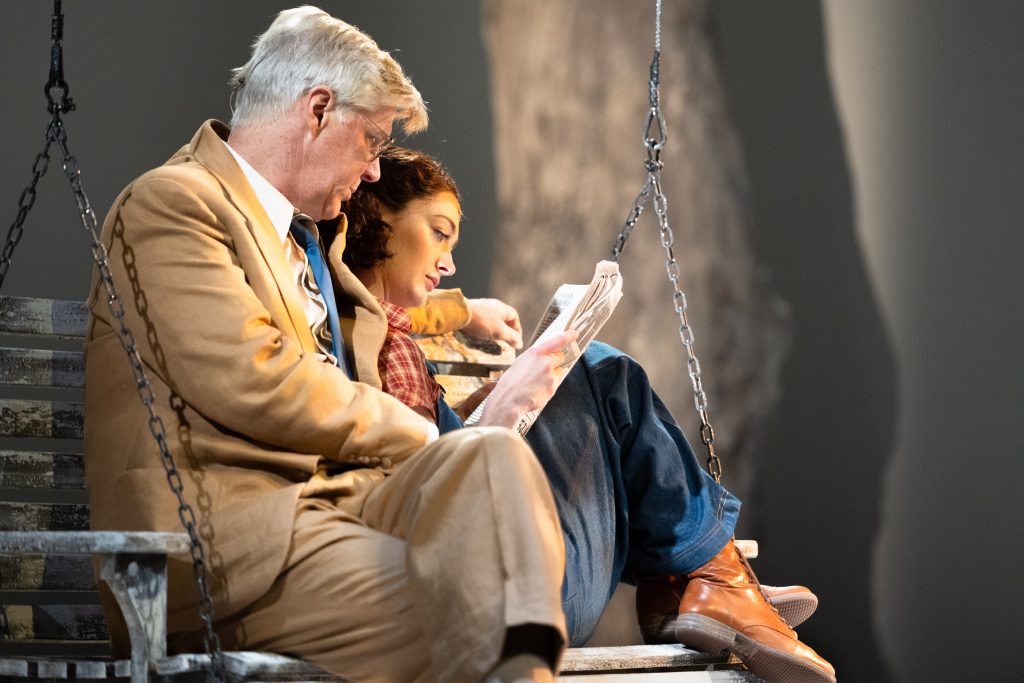
Aaron Sorkin has come along and shoehorned contemporary identity politics around race into this universal coming-of-age drama about a child trying to understand the adults in her world and how they treat people who look different, don’t fit it in, or are a different color. Sorkin undervalues empathy as a precursor to social justice and instead turns Atticus Finch into a petty liberal looking for thanks, and his moral compass looking for true north. Sorkin has misused his source material and has twisted a slice of real life into a Frankenstein of ill-fitting parts– but his creature never comes alive onstage.
It’s death by Sorkin– who was the wrong playwright to reinvent (as if it needed reinvention) this penetrating work. Make no mistake– I am a fan of his crackling style and frantic pace. It was just right for The Social Network, The West Wing, and one of my favorite courtroom dramas– A Few Good Men. But Sorkin’s snap-crackle sensibilities ride roughshod over the subtle rhythms of the time, the town, and the truths Lee reveals between the lines circumscribing the fictional but universally recognizable enclave of Maycomb, Alabama–barely onto itself and its bigotry. But Harper Lee was– and she needs no help from Sorkin.
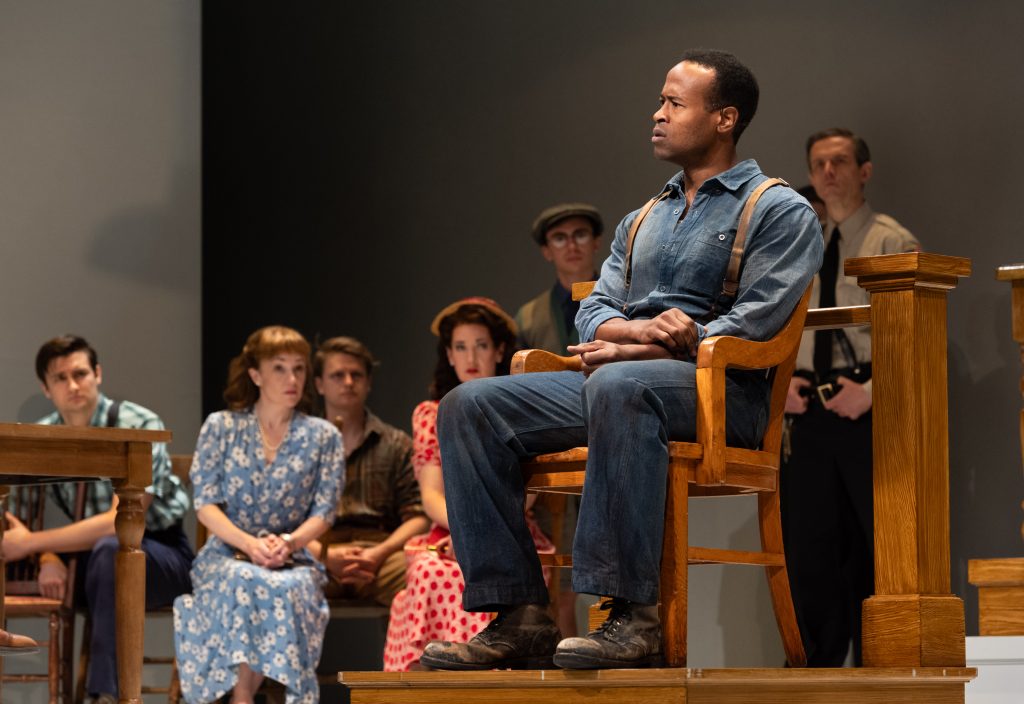
Key events are the same: a curious six year old–Jean Louise Finch aptly called “Scout”(Karen Killeen)– has her eyes on the horizon of the adult world. She idolizes her lawyer father Atticus Finch (a nondescript Karl Kenzler) and watches carefully as he stands up to his community at the intersection of race and class, by defending a Black man Tom Robinson (Rafael Jordan) falsely accused of raping a white woman. Sorkin narrows the focus and scrambles the chronology to more closely examine racism. Sorkin makes the plot less intimate by splitting Scout’s single first person point of view into three –shared by Scout and her older bother Jem (Benjamin Izaak) and visiting neighbor Dill (Andrew Stevens Purdy), now adults, and interrogating these events as well as Atticus’s response to them.
Calpurnia (Patrice Jean-Baptiste) the Finch’s Black housekeeper and surrogate mother to these motherless children, lashes out at Atticus for his condescension and for operating within a systemically racist system. She challenges Atticus’s idea that people are fundamentally good and we just need to stand in their shoes and all will be well. Yet this is precisely where Lee’s novel locates true justice — in empathy. Calpurnia’s stridency and anger flies in the face of the mutual respect she and Atticus share, is untrue to the character, and feels particularly contrived in this milieu.
The Huntington set is mostly a blank slate which destabilizes a sense of place. Flat light on swaths of vacant space are filled with talk. These characters feel like they floated in, ungrounded– like the lone swing lowered and raised from the rafters; there’s also a doorway through which characters enter and leave, leaving us no sense of where they came from or where they’re going. Occasionally the townsfolk enter from the audience but I could not feel the world they inhabit, physically or psychologically. 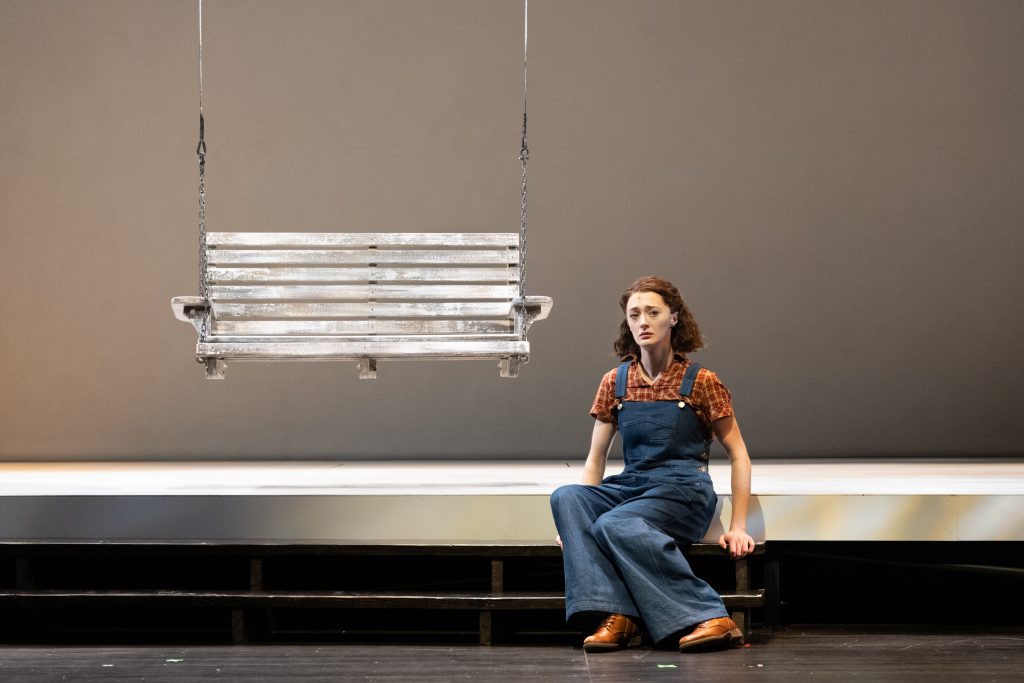
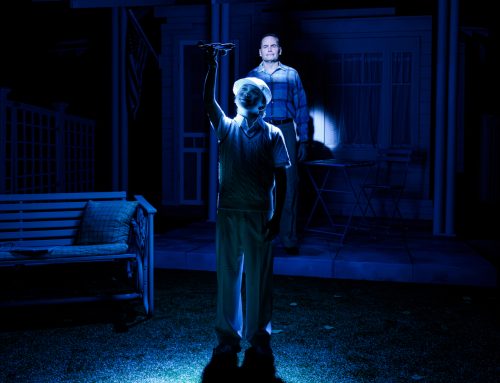
I so wanted to be enveloped by that big ol’ tree onstage, and the warm light of a summer afternoon, shining down on three kids spinning scary stories about their eccentric neighbor Boo Radley. In Sorkin’s drama, Boo (Jesse Hinson) is hardly involved until the climax when he comes out of nowhere– a true deus ex machina– stripped of any meaning which the novel imparts as the bogeymen we all concoct until we get a closer look. Sorkin should have dispensed with Boo completely– given that he’s devalued the reason for his being there at all.
Harper Lee’s tale has been accused of trading in “white savior”ism, centering whiteness, diminishing its Black characters, thereby reinforcing the racism which fueled a miscarriage of legal justice at the heart of the plot. By contrast, Sorkin’s version reeks of white guilt. Notably, Atticus does not save Tom though he uses his white privilege to right the scales of justice (should he not?). These political realities are already embedded in the novel. It’s worth noting we know more about Tom Robinson than we do of his white accusers Bob and Mayella Ewell (especially potent performances by Liam Craig and Jackie Scholl). And it’s no accident that the hideous Bob “Robert E. Lee” Ewell is named for one famous confederate general and rightly dies as a result of his murderous deeds. A higher moral justice is at work here in response to the rigged legal system which convicted and murdered Tom Robinson, and it’s dispensed by Atticus, the sheriff, and the judge who step outside that system. And what of Boo Radley? He too benefits from a empathic sense of justice beyond the legal limits which would have had him incarcerated.
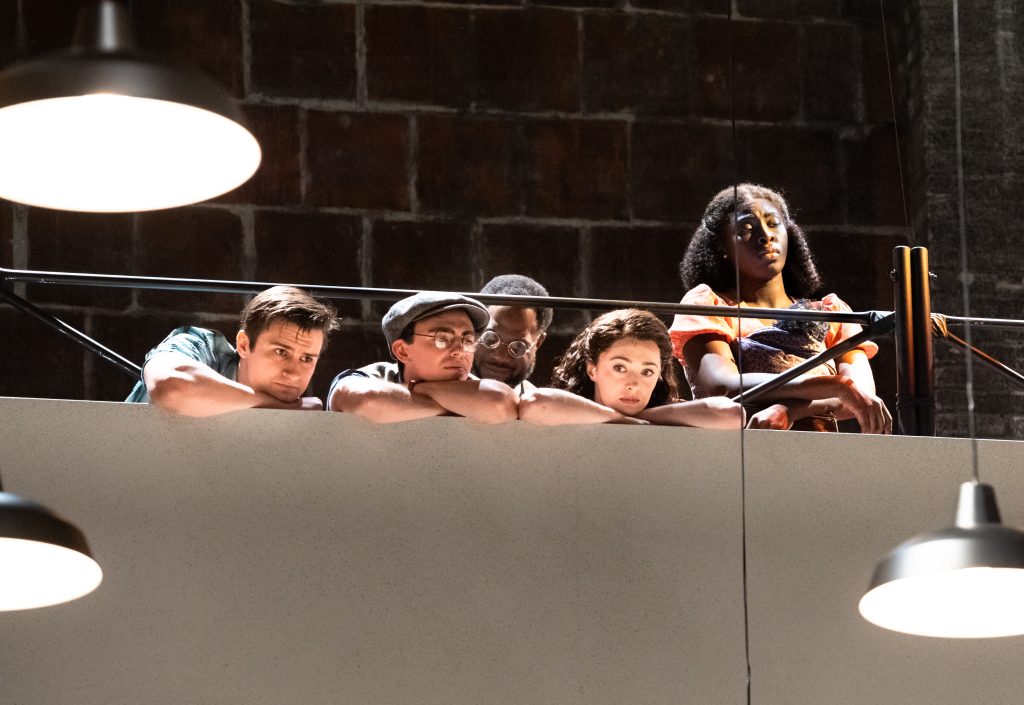
I have plenty of questions about this adaptation–Did we need to make sure that people understood that Atticus wasn’t ALL GOOD? Is it fair to think that Atticus as described by Harper Lee felt he was owed thanks? Should we hijack a book and its characters out of its historical context and an author’s point of view and deploy it in service of a different point of view which the original author does not explicitly hold?
See Harper Lee’s TO KILL A MOCKINGBIRD by Aaron Sorkin onstage through November 8 at THE HUNTINGTON and let me know what you think! I think it’s a dead duck.




Leave A Comment
You must be logged in to post a comment.