
I saw MELANIA on opening day, then went shopping at Costco. I know I got more for my money at the mass market retailer than I did for the mass market “crockumentary” made by director Brett Ratner. You may recall Ratner’s career took a nose dive after he was accused of sexual misconduct by six women including actresses Olivia Munn and Natasha Henstridge. (Photos of Ratner and Epstein with two young women, have just been released.) The First Lady and Executive Producer has thus put herself in familiar hands. Amazon’s Jeff Bezos put up the cash, 75 million dollars: $40 million to make, $35 million to market– which may be paying off. I saw it at the first show of the first day in a large suburban theater and was shocked to discover an almost full house– mostly older women. Trailer HERE!
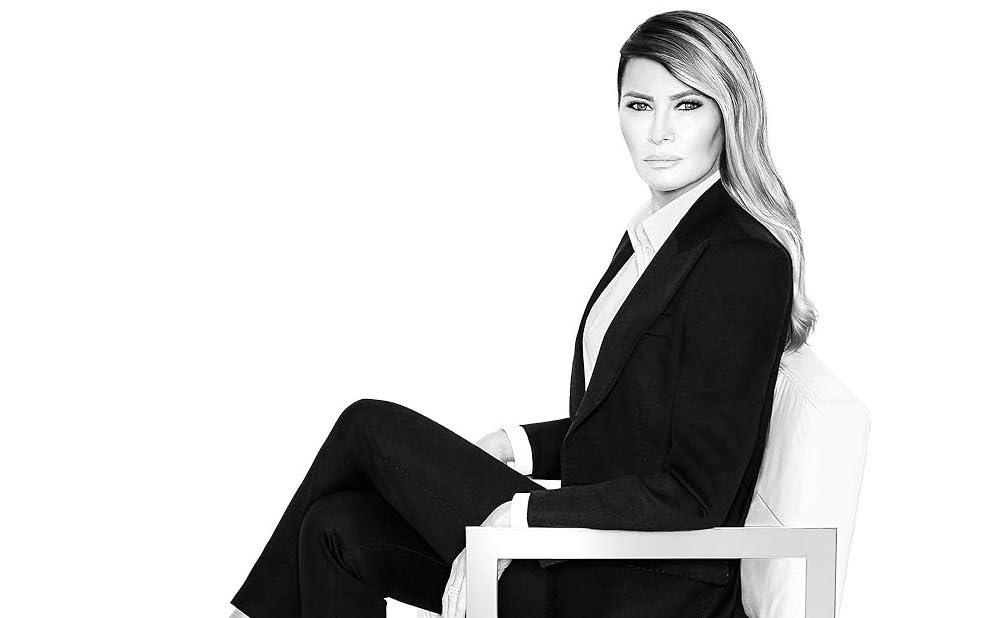
I went with my critic hat on and did my best not to prejudge, but to look at MELANIA as a documentary film and evaluate it outside of my personal political inclinations which are lately front and center and 180 degrees from those of the titular subject’s husband. I asked myself– did it work as a film? Did it show me something new about its subject? Something unexpected? Did it satisfy some curiosity? Did it alter my point of view? Did it compel me to watch? Did it document a heretofore unknown reality? What I found was a weird, soulless portrait of a First Lady as mannequin, a monument to vanity and high heels which sheds no light on anything remotely close to a real flesh and blood person preparing for an historic global event.
The movie begins with a sweeping aerial shot of the ocean and grounds surrounding Mar-a-Lago, closing in on a knockout pair of pumps on stone steps as the Rolling Stones “Gimme Shelter” is pumped out on the soundtrack. We’re just a shot away from an onslaught of similar shots lingering on a gorgeously coiffed, costumed, and made-up Melania as she swans through the 20 days leading up to her husband’s second inauguration and her resumption of her role as First lady. The film unfolds like a series of run-ways for a lanky former model who seldom breaks stride, expression, or a sweat. We’ve seen her mask and hoped to get a glimpse of what’s underneath– I think that’s why so many women went to see this film– curiosity about this buttoned up, controlled public person. What’s revelatory here–is what’s missing.
We never see her tired, or laughing, or rushing, or relaxing casually dressed, or in anything less than complete maquillage. We never hear her speak her native language, even to her father who is around for the proceedings, lumbering in and out of frame. We never see her talk to a friend, or her son, or say something playful to her husband who declares she’s “difficult” but “incredible” — as she smiles through her teeth.
We learn that her mother died in the past year, and in scripted voice over only, we hear her say how much her mother, a pattern maker, meant to her. We then watch Melania head into St. Patrick’s Cathedral one night, the camera dramatically tracking her solitary walk down its long, center aisle to the altar where she lights a candle, never kneels, never crosses herself–and we never see one solitary photo of this beloved mother who she reiterates will always be with her.
She references her love of design and her architecture studies, but we see no evidence of anything she’s ever designed. We watch her approve china and table settings and tweak her inaugural wardrobe all designed by others. She repeatedly insists on straight or sharp lines: across the gown, her blouse, and that hat (which hid half her face from the world), those straight lines echoed in a steady parade of pointy stilettos and pencil skirts. Her favorite colors are black and white–perhaps some mitigating shades of grey but no vibrant color. We see her interviewing people to be her assistant but never find out who’s chosen. She has professional conversations with First Lady Brigitte Macron of France and Jordan’s Queen Rania, enjoining them to sign on to her FOSTERING THE FUTURE INITIATIVE and BE BEST programs. We never get much detail on either despite her stated desire to “evolve the role of First Lady.” These programs and a few accomplishments are named like an afterthought in a brisk end-credit scrawl.
What passes for a glimpse behind the scenes is her obvious anxiety around her family’s safety during the presidential motorcade. We also see her singing along to her favorite song and entertainer Michael Jackson’s “Billy Jean.” Good song. Odd choice to feature on the soundtrack. There is a moment which promises something spontaneous, unscripted, heartfelt. It comes during a meeting with a hostage released from Gaza, a woman unadorned in her grief and fear for her husband who has been left behind. As the woman begins to cry, Melania moves over on the couch and embraces her as the camera zeros in– Melania perhaps too aware of the lens focused on her face.
There’s no crack in that perfectly composed, critic-proof visage. MELANIA is not even about Melania. It seems to be about buying influence and money: Melania is reportedly pocketing $28 million; the movie came in third at the box office on opening weekend confounding expectations; Jeff Bezos continues his quest to curry favor. Submission accomplished.