It’s a revelation: EUREKA DAY now onstage at THE HUNTINGTON THEATRE is a A WILDLY FUNNY satire with a pitch-perfect cast attempting to unravel the Gordion knot of woke communication in the real world where consensus is a dream. The Tony Award-winning play by Jonathan Spector is a spot-on parody of the post biblical Tower of Babel in which we have imprisoned ourselves, and does precisely what satire is meant to do– reveal ourselves to ourselves by making us laugh at the absurdity, thereby pointing a way forward.

PHOTO: Liza Voll
Spector sets the action at ground zero for liberal thinking as some of the most divisive issues of the day play themselves out: Eureka Day, a private, progressive, elementary day school in Berkeley, California. Here, a five-member board, including staff and a parent representative, meet to establish school policy. They pride themselves on their core values–absolute consensus, inclusivity, and conflict avoidance; but their complacency goeth before an epic fall when an outbreak of mumps causes major bumps in the road as they find themselves at odds over exactly what their vaccination policy should be. No matter how gingerly they step, it’s just a matter of time before they hit a landmine.
The core five of this superb six-member ensemble include the continually interruptive and un-self aware Eli (Japhet Balaban) who’s married but sleeping with soft-spoken Meiko (Sasha Diamond)–this extramarital excursion supposedly sanctioned by Eli’s wife. There’s the outspoken, over-compensating Suzanne (Nancy Lemenager) who patronizes reserved but confident Carina (Eunice Woods) the lone Black parent on the committee, whom Suzanne assures values her “unique perspective.” Presiding over all is the towering Ken Cheeseman, perfect as Principal Don, cheerfully welcoming every point of view, smoothing over all feathers before they’re ruffled, and capping off every meeting with a soulful reading by Sufi mystic poet Rumi. We’ve been in this room, and it’s beyond funny to see it from the outside, where what is unsaid is always understood no matter how PC –perfectly calibrated– the surface.
Director Margot Bordelon orchestrates this dense script and its cacophony of overlapping dialogue and subtext with a sure hand. We watch amused, as these sophisticated adult characters seated on little chairs in a remarkably appointed, extremely detailed classroom set (Luciana Stecconi), bring their elementary selves back to school. It’s not long before tantrums are thrown. Discord spreads like wildfire– slowly at first– then erupting into a conflagration fanned by social media when the committee decides to include the community in its conversation and livestream it on ZOOM!
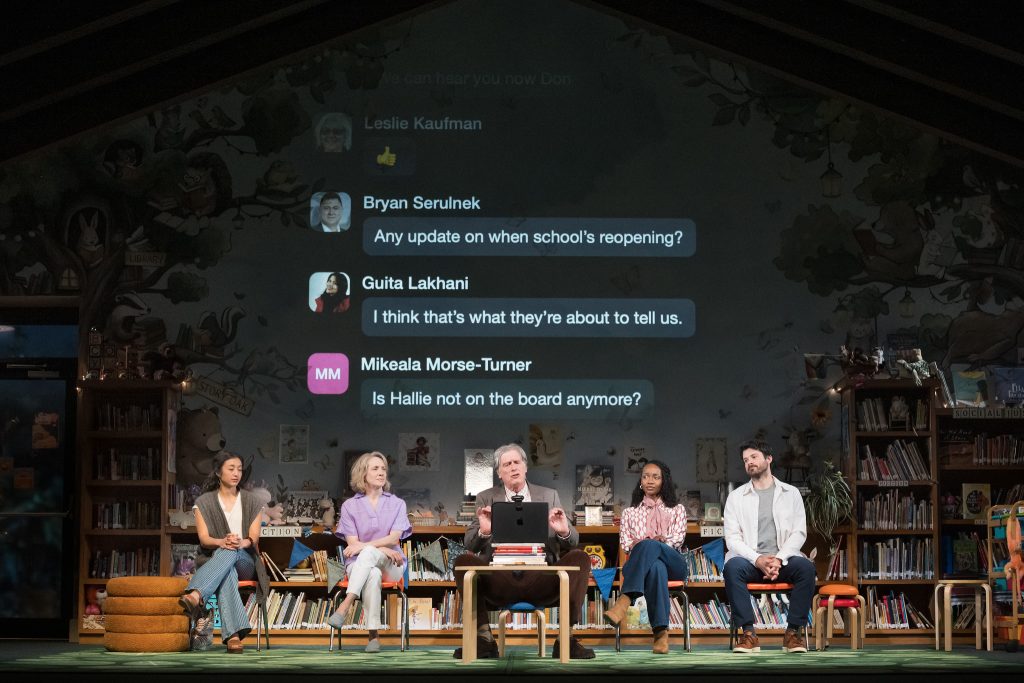
PHOTO: Liza Voll
Here, micro-aggressions and unconscious biases metastasize into malignant warfare in “the chat” where the public lets loose and everyone from chiropractors to Nazis are invoked. This chat, in all its toxic, idiotic splendor, is fully visible to the audience on a huge screen hovering centerstage, in hilarious counterpoint to the shocked committee below trying to maintain some semblance of decency and logic. The scene is a masterpiece, a brilliantly conceived and executed microcosm of societal inanity and dysfunction and will leave you in hysterics—
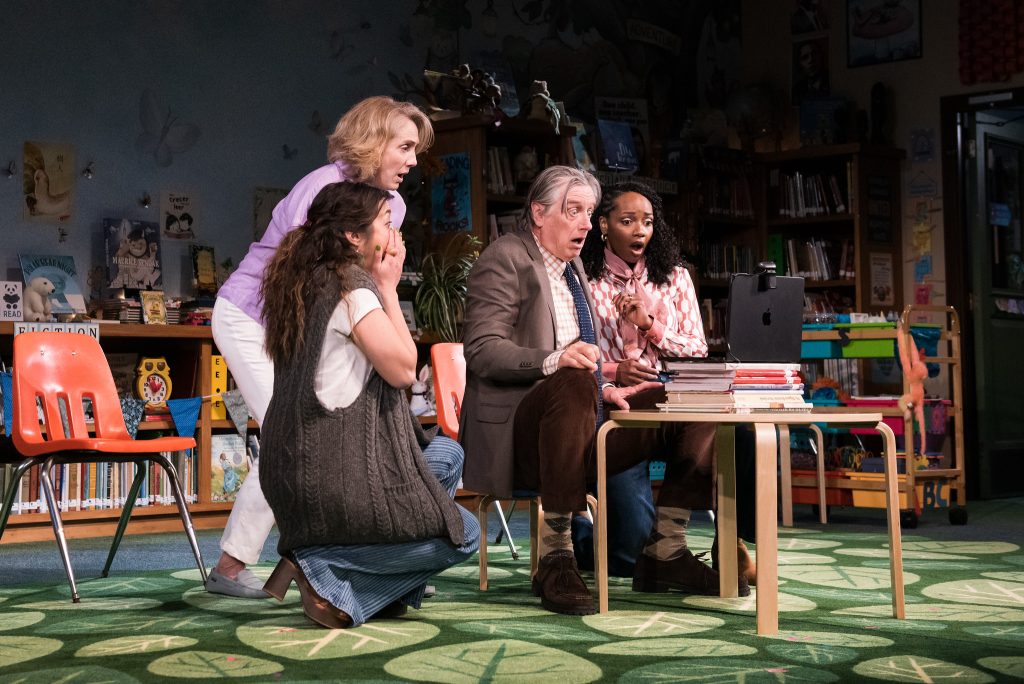
PHOTO: Liza Voll
–and thinking about the conundrums our thoughts are heir to. What ARE our core values? Does inclusivity end up “othering” everyone we include? How do we honor the minority in a system ruled by the majority? Contemporary life is already so absurd, satire is increasingly out of reach! The dialogue here almost writes itself. Yes, the zone is flooded, common ground is hard to find, yet health and safety, freedom of choice and speech, parenting, social justice, government intervention, what’s public, what’s private, identity, and other such foundational issues remain to be lived out. The characters in EUREKA DAY do find a practical, work around–but the play immediately assures us that just when we think we’ve got it down — we don’t. While EUREKA DAY provides no easy answers, it lets us look at ourselves with laughter and compassion, and suggests that a “Eureka” moment may involve less talking and more walking around in another’s shoes–perhaps the best path to common ground and a way forward.